How AI is Running Meta Ads Campaigns in 2026
Meta’s AI now automates targeting, budgets, and creative testing—advertisers with strong data and diverse creatives win.
Introduction
Meta's ad platform is not what it was three years ago. The interface looks similar. The campaign structure is familiar. But underneath, the system running budget decisions, audience selection, creative testing, and bid optimization is largely autonomous now. AI Meta Ads is not a feature toggle buried in Ads Manager. It's the default operating mode. Businesses that understand that are scaling. Businesses that don't are watching their cost-per-result climb while their competitors pull ahead.
What AI Is Actually Doing Inside Meta's Ad System
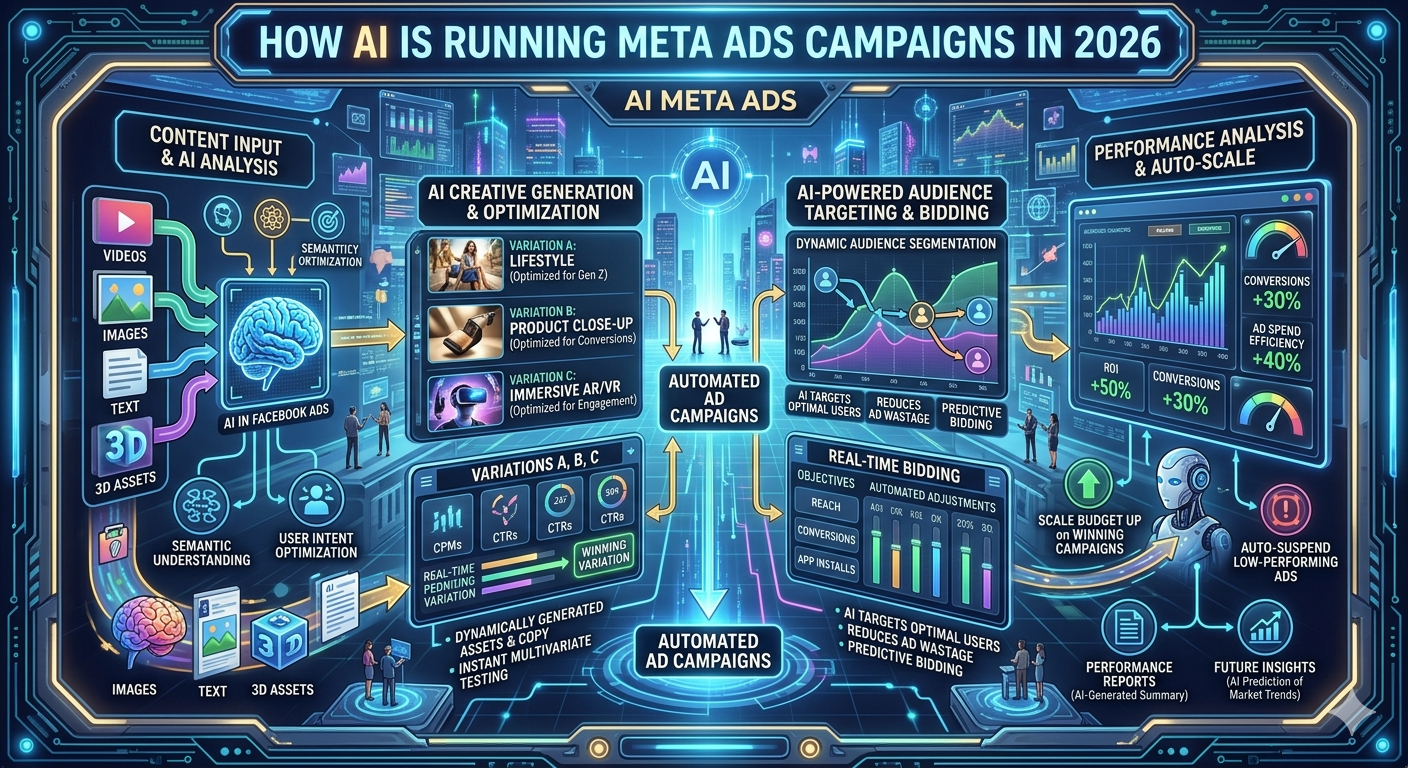
Meta's AI does not sit in one place inside the platform. It's distributed across every layer of a campaign. Advantage+ audience targeting removes the need for manual audience builds entirely. The system identifies who is likely to convert based on pixel data, behavioral signals, and cross-platform activity, then expands or contracts the targeting pool in real time without any human input. No saved audiences. No interest stacking. The model decides.
On the budget side, Advantage Campaign Budget operates dynamically across ad sets, moving money toward whichever placement and audience combination is generating results at that moment. Not at the end of the day. Not on a 24-hour cadence. Constantly. A static budget split across three ad sets is a relic now. The AI redistributes spend at a speed no human campaign manager can match.
AI in Facebook Ads: Where Creative Automation Enters the Picture
Creative is the last frontier that marketers thought AI couldn't touch. That belief did not survive 2025. Meta's Generative AI creative tools now produce background variations, image crops, text overlays, and ad copy expansions from a single uploaded asset. One original image. Dozens of variations tested in parallel. The system identifies which visual and copy combinations drive the highest click-through and conversion rates, then shifts impressions toward winning variants automatically.
And the implications here are significant for small businesses specifically. A solo operator running a Shopify store can now compete at a creative testing velocity that previously required a design team, a copywriter, and a media buyer working in tandem. The resource gap between a $500/month advertiser and a $50,000/month advertiser has narrowed in a way that nobody fully predicted.
Automated Ad Campaigns: What Advantage+ Shopping Actually Does
Advantage+ Shopping Campaigns represent Meta's most complete version of automated ad campaign management. The advertiser provides the creative assets and the destination URL. Meta's AI handles everything else. Audience, placement, bid, budget allocation, creative delivery. The system tests broad audiences against existing customer lists and retargeting segments simultaneously, not in isolated ad sets, but in a single unified campaign structure.
Results for e-commerce advertisers have been split. Brands with strong pixel histories and significant purchase data tend to see meaningful efficiency gains. Brands with thin data histories find the system takes longer to calibrate and can burn through budget during the learning phase. The AI is only as good as the signal it has to work with. Bad data in, bad decisions out. That principle has not changed.
What Human Media Buyers Actually Do Now
The role has shifted, not disappeared. Human strategists are no longer adjusting bids manually or building lookalike audiences from CRM lists. Those tasks are handled. What requires human judgment now is the stuff AI cannot source on its own: creative strategy, offer construction, brand positioning, and understanding why a product resonates with a specific segment of people. The AI optimizes toward a goal. But humans still define what goal is worth optimizing toward.
And there's a real skill premium emerging for marketers who understand how to feed Meta's AI effectively. Knowing how to structure campaigns for faster learning. Understanding how creative diversity affects system performance. Recognizing when the AI is stuck in a local optimum versus genuinely scaling. These are not entry-level skills. But they're different skills from what media buyers were practicing in 2019.
The Data Privacy Constraint Nobody Talks About Enough
Apple's ATT framework gutted signal quality across the board starting in 2021. Meta has been rebuilding its targeting infrastructure around modeled conversions and server-side signals ever since. The Conversions API is now table stakes, not optional. AI Meta Ads systems running without CAPI integration are operating blind on a significant portion of iOS traffic. The optimization data the AI receives is incomplete. And incomplete data produces campaigns that plateau faster than they should.
Meta's AI can model around data gaps to a point. But there's a ceiling. Businesses that have not implemented server-side tracking are leaving material performance on the table, specifically in the verticals, e-commerce, lead gen, subscription products, where conversion signal density is what separates a 3x ROAS campaign from a 6x one.
The Metrics That Matter Have Changed
Click-through rate was a vanity metric before AI automation took over. It's even less relevant now. The system is not optimizing for clicks. It's optimizing for the downstream event that was set as the campaign objective. If the objective is purchases, Meta's AI will sacrifice CTR to find purchasers. If the objective is leads, it will find lead submitters, not readers. Advertisers who are still evaluating campaign health by CTR benchmarks are measuring the wrong thing.
Cost per result, return on ad spend, and cost per qualified lead are the numbers that reflect what the AI is actually doing. But even those require context. A 2x ROAS in week one of an Advantage+ campaign is not the same as a 2x ROAS after four weeks of model calibration. The trajectory matters as much as the snapshot.
Conclusion
AI Meta Ads in 2026 is not a tool businesses choose to use or ignore. It's the infrastructure the platform runs on. Campaigns that fight the automation by over-constraining audiences, manually overriding budgets, or uploading a single static creative are working against the system's design. The advertisers winning right now are the ones who understand how to structure campaigns so Meta's AI has what it needs to perform: clean data pipelines, creative variety, the right objective, and enough budget to move through the learning phase without pulling the plug early. The platform handles execution. Strategy is still a human job.