How AI Search is Changing SEO in 2026
AI search engines are rewriting SEO in 2026, and businesses that ignore it will vanish from the conversation entirely.
Introduction
The rules changed. Not gradually — fast. The AI search engine didn't just show up and tweak a few ranking signals. It rewired the entire system that SEO professionals spent two decades learning. Businesses that were sitting comfortable on page one in 2023 started losing organic traffic in ways they couldn't explain. Because the question wasn't just "are we ranking?" anymore. The question became: “Is the AI even mentioning us?” That's a fundamentally different game.
The Death of the Ten Blue Links Nobody Asked For
Google's Search Generative Experience. Perplexity. Bing Copilot. These aren't search engines in the traditional sense — they're answer engines. And answer engines don't need to send users anywhere. The click-through rate on AI-generated summaries sits substantially below standard organic results. Some industry data puts it at a 60-70% reduction in CTR for informational queries. Gone. Not declining. Gone.
The old model was simple: rank high, get clicks, convert. That model still works. But it works for a shrinking slice of queries. Transactional searches, hyper-local intent, brand-specific navigation — those still drive clicks. But "how does X work" or "what's the best Y for Z"? The AI answers it directly. No visit required.
What Search AI Algorithms Actually Reward Now
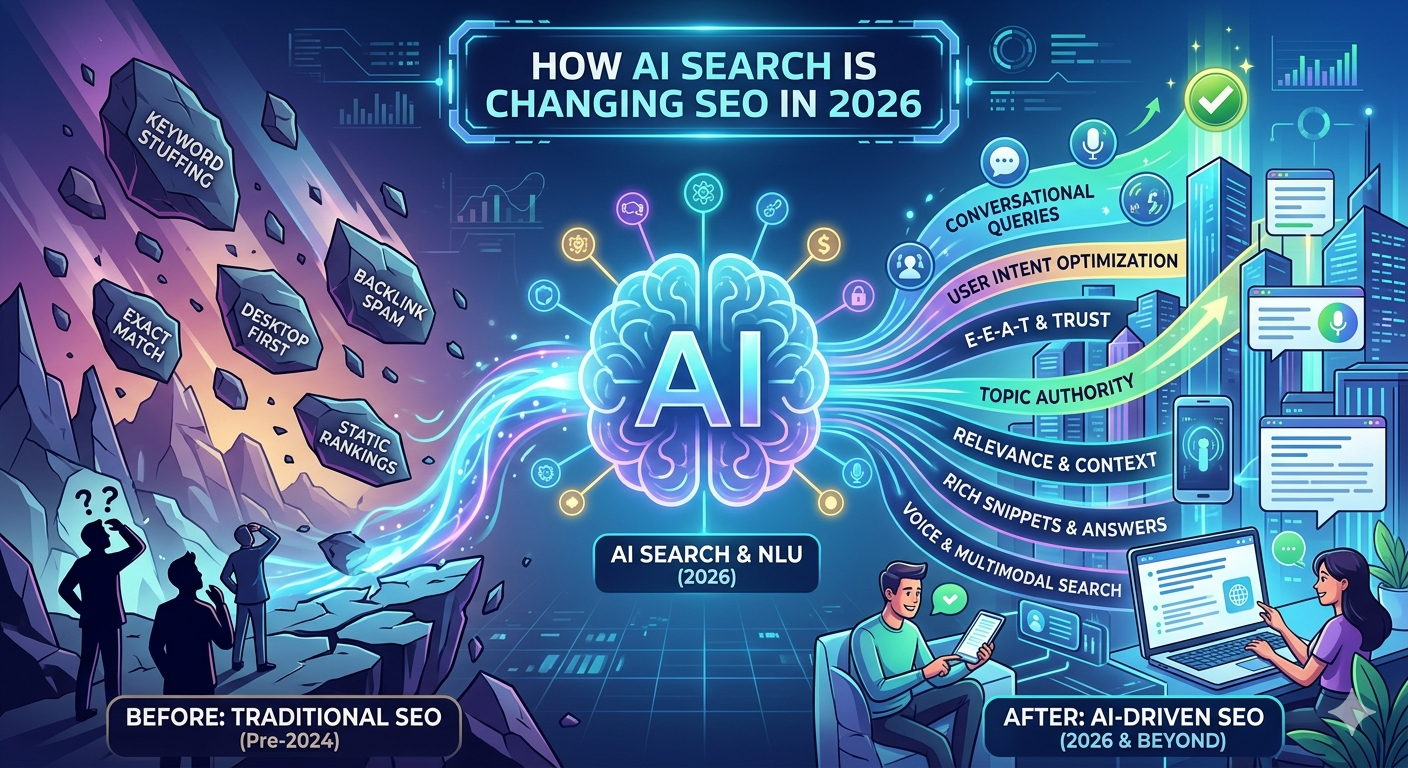
AI content ranking in 2026 doesn't operate on keyword density. It never really did, but now the gap between what SEOs thought mattered and what actually matters is enormous. Search AI algorithms are pulling content into their answer synthesis based on a few things that have nothing to do with backlink counts.
Entity authority is one. If Google's Knowledge Graph or a similar structured data layer doesn't know who a business is — doesn't have clear signals about what they do, who they serve, where they operate — that business is invisible to the summarization layer. It doesn't matter how many blog posts are published. The entity isn't recognized.
Citation worthiness is another. AI models generating answers want to cite reliable, specific, verifiable information. Vague content gets skipped. Numbers, dates, named sources, proprietary data — these signal that the content is worth pulling from. Generic "10 tips for productivity" articles don't make the cut.
The Content That Survives
Not everything is dying. Some content formats are thriving precisely because AI can't generate them. Original research. Proprietary case studies. First-person industry accounts written by practitioners with real skin in the game. Niche technical documentation. These are the pieces that AI answer engines cite — because the AI can't fabricate that data on its own.
Businesses investing in original data studies — even small-scale surveys with a few hundred respondents — are seeing those assets cited in AI-generated answers repeatedly. It's a compounding return. The content doesn't just rank once. It becomes a reference point that feeds into AI responses for months.
Short, vague blog posts aren't dead because AI wrote them. They're dead because they never provided unique value. The AI just exposed that faster.
Technical SEO Didn't Get Simpler
Some people assumed that if AI is doing the searching, technical SEO would matter less. Wrong. The opposite happened. AI crawlers and retrieval systems are stricter about structured data than Google's old crawlers ever were. Schema markup, clear site architecture, fast server response times, and clean semantic HTML — these are now prerequisites for even being considered by AI retrieval pipelines.
Search AI algorithms also rely heavily on entity relationships expressed in structured data. A business without proper Organization schema, without consistent NAP (name, address, phone) signals across the web, without clear topical clustering — that business is harder for the AI to understand. And things the AI doesn't understand don't get surfaced. Simple as that.
PageSpeed isn't a nice-to-have anymore. Crawl efficiency is survival.
The New Metric Nobody Is Tracking Well Yet
Traffic. Clicks. Rankings. These are still being tracked. But the metric that actually matters in the AI search era is AI mention rate — how often a brand, product, or piece of content appears in AI-generated answers across major platforms.
There's no clean, standardized tool for this yet. Some SEO platforms are building toward it. Brands are running manual checks across Perplexity, ChatGPT, Gemini, and Copilot. It's messy. But businesses that are monitoring this are getting early signals about where their content strategy is actually working — and where they're completely absent from the conversation.
Ranking #1 on Google for a keyword while being completely absent from AI-generated answers for that same query is not a sustainable position. Both need attention.
Who Is Winning Right Now
Specialists are winning. Not generalists. Sites that dominate a narrow topic — that have 200 articles all tightly scoped to a specific industry vertical with real expertise behind them — are getting pulled into AI answers at a higher rate than massive content farms covering every topic poorly. Depth beats breadth. Every time.
Media brands with original reporting are winning. Because AI needs to cite something, and something verifiable from a known publication beats AI-generated fluff.
B2B SaaS companies with strong technical documentation are winning. Because developers and buyers are using AI search to evaluate tools, and if the documentation is good enough to be cited in an AI response, that's a conversion touchpoint that didn't exist three years ago.
What's Still Broken
Attribution is a disaster. When an AI search engine cites a piece of content or references a brand, the traffic doesn't always flow back. The brand gets mentioned. The content gets used. But the analytics show nothing. For businesses that built their entire marketing reporting structure around GA4 and UTM parameters, this is a genuine blind spot. Revenue is being influenced by AI-driven brand recognition, and the measurement infrastructure doesn't capture it.
And spam isn't gone. AI content ranking systems are smarter than the old keyword-stuffing era, but there's a whole ecosystem of low-quality AI-generated content being published at scale with the hope of tricking search AI algorithms. It's partially working in some niches. Google and other platforms are in an arms race with it. The short-term gains from that approach are real, but the volatility is extreme.
Conclusion
The AI search engine era isn't coming. It's here. What's still unfolding is the second and third-order effects — how measurement catches up, how content strategies adapt, how technical standards evolve to serve retrieval pipelines instead of just traditional crawlers.
Businesses that treat this as a temporary disruption are going to be behind for a long time. The ones taking it seriously — investing in entity authority, original research, technical depth, and AI mention monitoring — are building presence in a way that compounds. Rankings still matter. But being present in the AI answer layer might matter more.
The work isn't easier. But it's clearer than it's ever been. Do the real work, create genuinely useful content, and the AI search systems will find it worth citing. That's the new benchmark.