How to Increase Your Visibility on Google Through SEO in 2026
Traffic looks fine one week. Then it drops. Hard. Pages that once pulled steady clicks suddenly stop moving. No warning. No clear reason.
Introduction
Traffic looks fine one week. Then it drops. Hard. Pages that once pulled steady clicks suddenly stop moving. No warning. No clear reason.
This is happening across industries. Not just small blogs. Even established sites are feeling it. Because Search Engine Optimization has changed faster than most strategies can keep up.
And the uncomfortable truth? Publishing more content isn’t fixing it.
Some websites push 50 articles a month and still struggle. Others publish less—but dominate search results. The difference isn’t effort. It’s clarity. Direction. Execution.
Because visibility on Google doesn’t come from activity alone. It comes from alignment—between content, intent, and authority.
What Increasing Visibility Through SEO Actually Looks Like
Visibility isn’t about rankings alone. That’s where most strategies go wrong.
A page ranking on page one but getting no clicks? That’s not visibility. That’s wasted positioning.
Real visibility includes:
- Showing up for the right searches
- Getting consistent clicks
- Holding user attention
- Driving meaningful actions
Search Engine Optimization connects all of this. Not just keywords. Not just backlinks. It’s a system now—deeply tied to Digital marketing as a whole.
Why SEO Feels Different in 2026
Things shifted. Quietly at first. Then all at once.
AI Content Flood Changed the Game
Thousands of pages now look identical. Same structure. Same tone. Same predictable flow.
Google adjusted.
Low-value content isn’t just ranking lower—it’s being filtered out completely. Pages need substance now. Real substance.
Users Have No Patience
Clicks are fast. Decisions are faster.
- A few seconds to hook attention
- A quick scroll to judge relevance
- Exit if it feels generic
And generic content is everywhere.
So pages that don’t immediately connect? They lose.
Authority Is Harder to Build
Random content doesn’t work anymore.
Websites need consistency in topic. Depth across related areas. A clear signal that expertise exists—not just surface-level writing.
Because Google isn’t ranking pages in isolation anymore. It’s evaluating entire sites.
Strategies That Actually Increase Google Visibility
No fluff. Just what’s working right now.
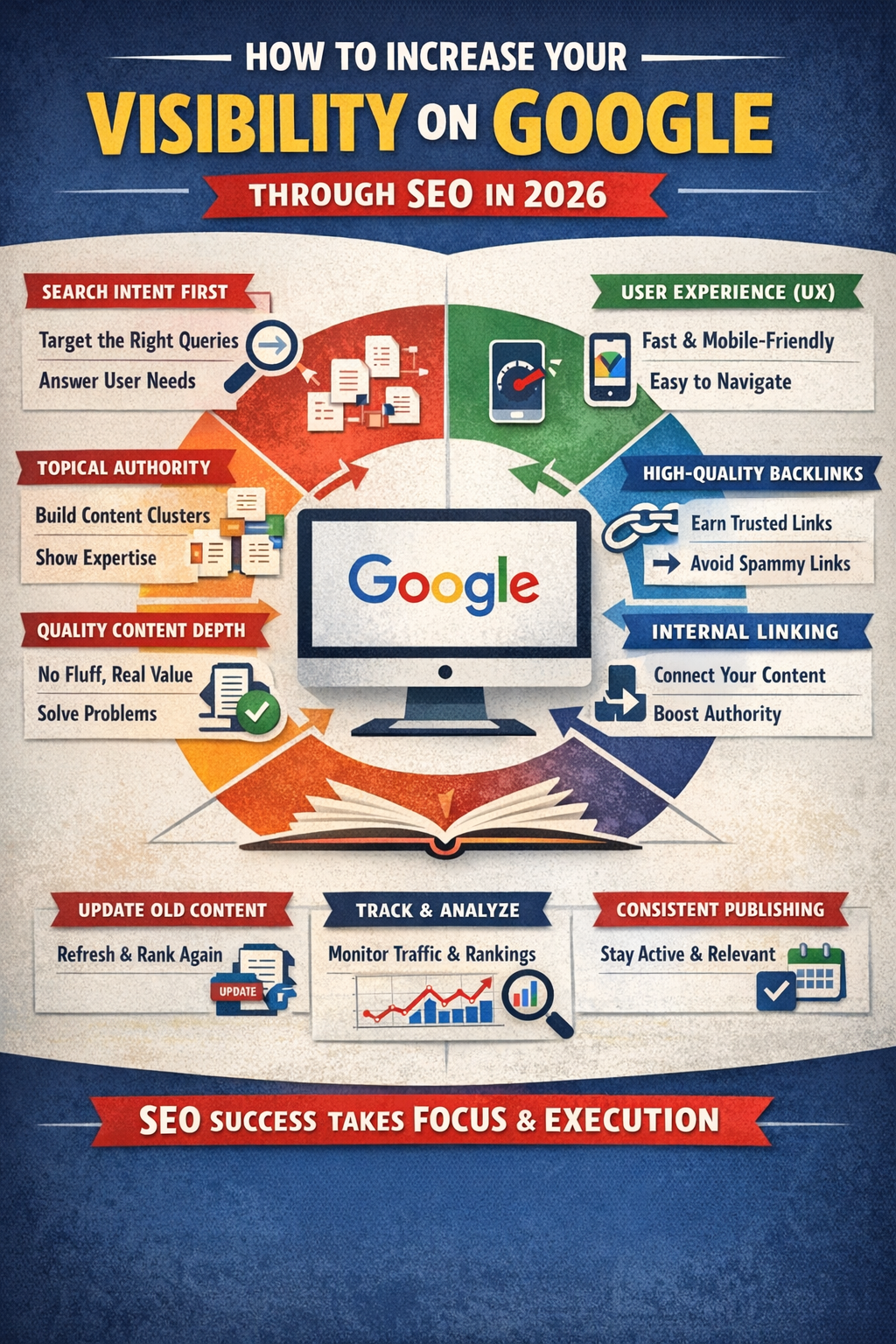
1. Search Intent Is the Starting Point
Keywords still matter. But intent decides everything.
A page targeting “SEO tips” without actionable insights won’t survive. A page targeting “how to fix traffic drop” without specific steps gets ignored.
Because users aren’t searching for words. They’re searching for outcomes.
Strong content does this:
- Matches the exact need behind the query
- Removes unnecessary explanation
- Delivers answers quickly
Sometimes shorter content wins. Because it respects intent.
2. Content Needs Depth, Not Just Length
Long articles don’t guarantee rankings anymore.
Depth does.
A focused 1,000-word guide that solves a real problem can outperform a 3,000-word general article filled with filler sections.
Real depth includes:
- Specific scenarios
- Clear solutions
- Real-world applications
Not definitions. Not repetition.
3. Build Topical Authority Through Clusters
Single blog posts rarely move the needle now.
Clusters do.
A website publishing one article on SEO sends a weak signal. A website covering SEO from multiple angles builds authority fast.
Example cluster:
- SEO basics
- Technical SEO fixes
- On-page optimization
- Content strategy
- Link building
All connected. All supporting each other.
Because Google trusts coverage, not isolated effort.
4. On-Page SEO Must Feel Natural
Over-optimization is easy to spot now.
Pages stuffed with keywords feel robotic. Headings that repeat the same phrases don’t help.
What works instead:
- Natural keyword placement
- Clear structure with logical headings
- Readable paragraphs
- Internal links that add value
Search Engine Optimization should be present—but not obvious.
5. Internal Linking Builds Hidden Strength
This gets ignored far too often.
Internal links create structure. They guide users. They help search engines understand relationships between pages.
Effective internal linking:
- Connects related topics
- Uses relevant anchor text
- Avoids forced placement
Because disconnected content weakens a site. Connected content builds authority.
6. Backlinks Still Matter—But Standards Are Higher
Quantity doesn’t impress anymore.
Relevance and quality decide impact.
A few strong links from trusted sources outperform dozens of weak ones.
Effective link building includes:
- Guest posting on relevant sites
- Industry mentions
- Strategic collaborations
Digital marketing plays a key role here. Visibility outside search feeds authority inside search.
7. User Experience Directly Impacts Rankings
Google watches behavior closely.
If users click and leave quickly, rankings drop. Simple.
Key UX factors:
- Fast loading speed
- Mobile optimization
- Clean layout
Cluttered pages confuse users. Slow pages lose them.
Better experience = better engagement = better rankings.
8. Consistency Outperforms Short Bursts
Publishing heavily for a short period doesn’t work long term.
Consistency does.
Sustainable approach:
- Regular content updates
- Ongoing optimization
- Steady publishing schedule
Because SEO builds gradually. Then compounds.
Real-Life Case: From Stagnation to Growth
A niche website struggling for months. Traffic flat. Rankings stuck.
The issue wasn’t effort. It was direction.
Problems identified:
- Random topics with no connection
- Weak internal linking
- Thin content on key pages
Changes implemented:
- Structured content around core topics
- Improved content clarity and usefulness
- Removed low-value pages
- Strengthened internal links
Outcome:
- Traffic doubled within three months
- Multiple keywords reached page one
- Engagement improved significantly
No shortcuts. Just focused execution.
Common Mistakes That Kill Visibility
These patterns show up repeatedly.
Ignoring Search Intent
Content doesn’t match what users actually want.
Publishing Generic Content
Nothing stands out. Nothing sticks.
Overloading Keywords
Feels unnatural. Hurts readability.
Skipping Technical Fixes
Slow pages. Broken links. Indexing issues.
Inconsistent Publishing
No momentum. No growth.
Each mistake reduces visibility. Gradually. Then completely.
Pro Tips That Make a Real Difference
Small adjustments. Big outcomes.
Update Old Content Regularly
Older posts lose relevance over time.
Refreshing them often brings faster gains than publishing new ones.
- Add updated information
- Improve structure
- Strengthen examples
Focus on Click-Through Rate
Ranking doesn’t guarantee clicks.
Titles matter. A lot.
Improve CTR by:
- Writing sharper headlines
- Creating curiosity
- Avoiding generic phrasing
Because visibility starts with attention.
Build Recognizable Authority
Anonymous websites struggle more now.
Trust signals matter.
Strengthen authority through:
- Consistent topic coverage
- External mentions
- Strong Digital marketing presence
Solve Problems Better Than Competitors
Search results are crowded.
Most pages say the same thing.
The winning page:
- Explains clearer
- Delivers faster
- Feels more useful
That difference matters.
Conclusion
Search Engine Optimization in 2026 isn’t about doing everything. It’s about doing the right things consistently.
Visibility comes from alignment:
- Content that matches intent
- Structure that builds authority
- Experience that keeps users engaged
And progress isn’t instant. It builds. Slowly at first. Then faster.
Some sites adapt. Others stay stuck.
The gap between them keeps growing.