What is Generative Engine Optimization (GEO)?
GEO is the practice of structuring content to earn citations from AI search tools, not just traditional search rankings.
Introduction
Search is not what it used to be. Google still exists. People still type queries. But a growing segment of users no longer click through ten blue links and sort through answers themselves. They ask an AI and get the answer directly. No scrolling. No tabs. No comparison shopping between websites. Just a response. That shift changes everything for businesses that built their digital presence on traditional SEO. Generative Engine Optimization is the discipline that's rising to meet that change head-on.
What Generative Engine Optimization Actually Is
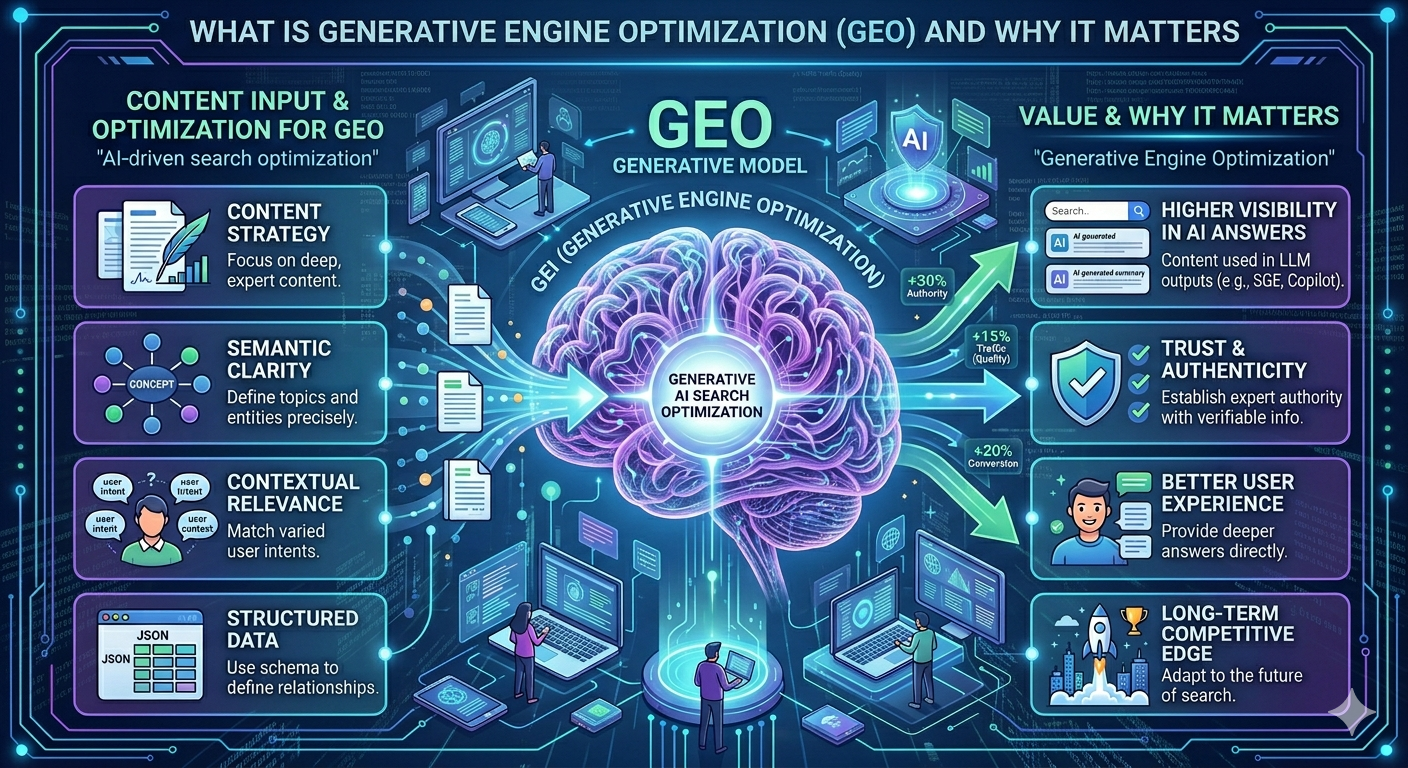
Generative Engine Optimization (GEO) refers to the practice of structuring and positioning content so that large language models (LLMs) and AI-driven search tools, like Perplexity, ChatGPT Search, Google AI Overviews, and Bing Copilot, cite, surface, or reference that content in their generated responses. Not ranked. Not clicked. Referenced. The distinction matters because the mechanism is completely different from traditional search. There is no PageRank equivalent pulling GEO strings. The AI reads, synthesizes, and selects. It doesn't just match keywords.
Traditional SEO worked on the premise of earning position on a results page. GEO works on the premise of being the source an AI trusts enough to quote. Two different games. One is about real estate on a list. The other is about credibility inside a machine that competes to give the best single answer.
Why AI-Driven Search Optimization Is Breaking Old Playbooks
Standard SEO had a rulebook. Backlinks, anchor text, crawl budgets, title tags. Businesses spent years, sometimes decades, learning to play that game. AI-driven search optimization operates by different mechanics. Relevance still matters, but it's not relevance to a keyword. It's relevance to an intent, interpreted by a model that can read between lines, detect authority, and weigh specificity against vagueness.
Thin content dies first. Always. An AI generating a response about tax-loss harvesting doesn't pull from a page that says "tax-loss harvesting is a strategy that can reduce your tax burden." It pulls from the page that explains how, when, for whom, and under what conditions. Depth of signal becomes the primary currency. Keyword density is largely irrelevant.
The other thing that changes: traffic attribution gets murky. Traditional search sent users to a site. Generative search surfaces an answer. The user gets what they need without ever visiting any domain. For publishers and content businesses, that's a structural revenue threat. But for brands that get cited as authoritative sources, it's an endorsement that no paid media budget can replicate.
The Mechanics Behind Generative AI Search Optimization
There's no single algorithm to reverse-engineer here. Different AI systems pull from different places. Perplexity indexes live web data and cites sources directly. Google AI Overviews synthesize from Google's existing index. ChatGPT with search pulls and attributes. Each system has its own retrieval logic. But patterns exist across all of them.
Specificity consistently outperforms generality. Structured content, things like tables, clearly defined steps, named methodologies, and attributed data, gets picked up at higher rates. Credibility signals still matter: citations, author credentials, publication context, institutional backing. And speed of trust matters. An AI has milliseconds to decide if a source is worth quoting. Content that frontloads its authority and states conclusions clearly performs better than content that buries the lead in brand voice and narrative warmup.
Who Gets Left Behind
Small businesses with thin content libraries. Brands that have been optimizing for impressions, not authority. Content farms. Aggregator sites that added little original value and survived on keyword volume alone. All of these built strategies perfectly calibrated for a game that is changing shape underneath them.
The businesses winning GEO early are not necessarily the biggest ones. They're the most specific ones. A regional law firm that publishes genuinely detailed, jurisdiction-specific legal breakdowns is outperforming national generalist sites in AI-cited results for niche queries. Specificity is now a competitive moat.
Tactical Moves That Actually Work
Creating content for generative AI search optimization is not a complete overhaul of what good content means. It's an evolution. Original research performs. Primary sources get cited. Data, statistics, and concrete numbers signal credibility to LLMs in ways that descriptive prose does not. First-hand expert opinion from named, credentialed individuals outperforms anonymous brand voice.
Structured formats help. FAQ sections map directly onto the way AI systems handle question-answering tasks. Step-by-step guides with numbered sequences appear in generative responses at elevated rates. Concise summary blocks at the top of articles, structured like a brief, authoritative answer, act almost like metadata for AI retrieval. These are not hacks. They're a natural result of writing for how AI systems actually process information.
Distribution and canonicalization still matter. Getting content republished or cited on authoritative third-party platforms increases the likelihood that an LLM's training data or live index includes a credible reference to that content. Building a presence in the sources AI systems trust, publications, databases, directories, industry bodies, is not traditional link-building. But it rhymes.
The Measurement Problem
Here's where things get genuinely uncomfortable for performance marketers. Generative AI search optimization is extremely hard to measure right now. There is no impression data from an AI Overview cite. Perplexity shows sources, but tracking referral traffic from AI systems is inconsistent and often missing UTM parameters. Attribution models are not built for this.
The honest answer is that most businesses don't yet have a clean way to quantify GEO return on investment. Brands are running proxy metrics: monitoring whether their name, products, or content appear when specific AI queries are run manually. Some are using brand mention tracking tools that crawl AI outputs. Neither is rigorous. The measurement infrastructure is 18 months behind the behavior change it's supposed to track.
The Stakes for Businesses That Ignore This
Generative engine optimization is not a future-proofing exercise. It's already affecting traffic patterns. Sites are seeing organic referral traffic shift. Long-tail queries, the ones that used to send highly qualified visitors through search, are increasingly being answered without a click. AI-driven search optimization is the response to that structural change. Businesses that treat GEO as optional will watch their addressable audience shrink in slow motion, category by category, query by query.
The question is not whether AI search changes digital marketing. It already has. The question is whether businesses are adjusting to what the new referral ecosystem rewards.
Conclusion
Generative engine optimization is not a trend waiting to matter. It matters now, imperfectly and incompletely, but the direction of change is not ambiguous. AI systems are becoming primary information interfaces for millions of users. The businesses that earn citations and references from those systems gain an authority position that traditional rankings cannot replicate. Getting there requires producing content that AI systems trust, not content that tricks old algorithms. The standard for earning that trust is high. And it's going to get higher.