Why Most Google Ads Tutorials Don’t Work in Real Life
Most Google Ads tutorials teach theory, not reality. Here's what actually breaks campaigns when businesses try to apply that textbook knowledge.
Introduction
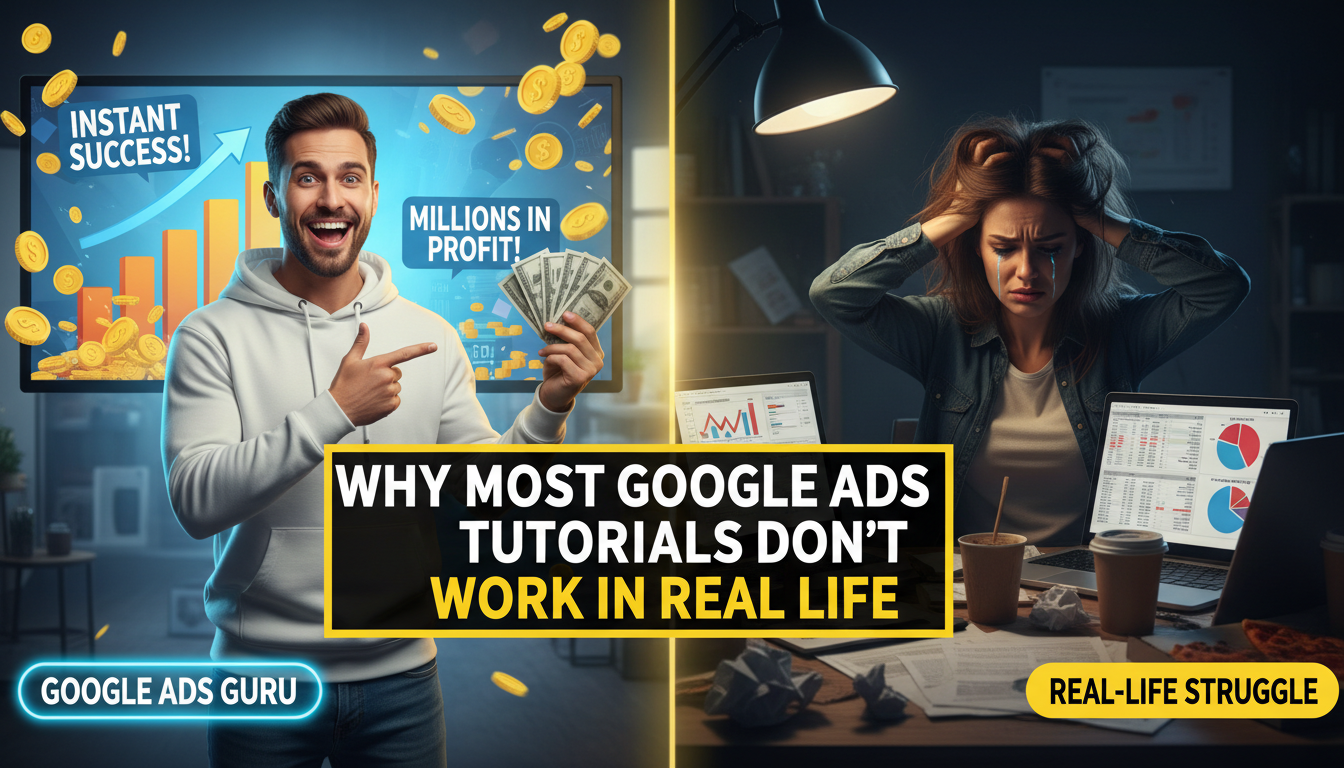
There's no shortage of Google Ads tutorials online. YouTube, blogs, Reddit threads, paid courses. Thousands of them. And yet, businesses follow those tutorials step by step, launch their campaigns, and watch the budget drain without a single conversion to show for it. Not because Google Ads doesn't work. But because what gets taught in tutorials almost never reflects what happens inside a live account with real money on the line.
The gap is enormous. And it's costing businesses real money every single day.
The Tutorial World vs. The Real Account
Most tutorials are built in demo environments. Clean data. No competition. No Quality Score history dragging performance down before the campaign even breathes. Instructors walk through a "perfect" campaign setup like a surgeon demonstrating on a mannequin. But actual Google Ads accounts? They bleed. They have legacy settings from whoever ran the account three years ago. Bad match types baked in. Conversion tracking that fires on the wrong page. Audience lists built on junk traffic.
Tutorials don't show that. They can't. Because showing a broken account would break the narrative.
Google Ads Mistakes Tutorials Never Mention
Broad Match Is Not a Learning Tool. It's a Budget Shredder.
Every beginner Google Ads tutorial pushes broad match keywords with the explanation that "Google's AI will find the right audience." That's the pitch. The reality? Without a strong negative keyword list, without a well-structured audience signal, and without enough conversion history to guide Smart Bidding, broad match will spend $800 on completely irrelevant search terms before the algorithm figures anything out.
Businesses run out of budget before the "learning" even completes. And then they blame Google Ads.
The Conversion Tracking Step Gets Glossed Over. Every Time.
Tutorials spend 40 minutes on ad copy and maybe 90 seconds on conversion tracking. That's backwards. Dead wrong. Conversion tracking is the entire foundation of performance. Without it firing correctly, the campaign is flying blind. Google's bidding algorithms are optimizing toward nothing. And businesses are making decisions based on data that means nothing.
Quality Score Isn't Fixed By Writing Better Headlines
A lot of tutorials treat Quality Score like a headline problem. Just write better copy. Tighten the CTA. But Quality Score is a product of landing page relevance, expected CTR, and ad relevance together. Businesses with slow, generic landing pages that have a 12-second load time and one paragraph of filler text will not fix that with a "Top 5 Ad Copy Tips" video. The page is the problem. The tutorial never gets to the page.
Why Google Ads Real Results Look Nothing Like Tutorial Results
Tutorial creators often work in niches with low competition and high-intent traffic. They pick keywords that convert easily. Or they show results from accounts that have been running for 18 months with a mountain of conversion data feeding Smart Bidding. Then they present a "Getting Started" tutorial based on those conditions.
New accounts don't have that data. Competitive niches don't have those CPCs. And a $50/day budget does not behave like a $500/day budget. The math changes. The algorithm behaves differently. The auction dynamics shift entirely. But tutorials never disclose any of this. Results matter. Context matters more.
The Smart Bidding Trap
Target CPA and Target ROAS sound like the obvious move after watching any decent tutorial. Set a target, let Google optimize. Simple. Except those strategies require a statistically significant volume of conversions to function properly. The number varies by industry, but the general threshold for Target CPA is at least 30-50 conversions in a 30-day window. Most small businesses don't hit that. So Smart Bidding makes erratic decisions, underbids in high-value auctions, overbids in low-value ones, and delivers confusing results. And nobody in the tutorial mentioned that Manual CPC or Maximize Clicks might be a smarter entry point for accounts with thin conversion data.
What Actually Works. And Why It's Hard to Teach.
Real Google Ads performance comes from iteration. From reading the search terms report and catching irrelevant spend before it kills the budget. From recognizing that a 6% CTR on a branded campaign and a 1.2% CTR on a non-branded campaign are both potentially fine. Context matters. From understanding that a campaign underperforming in week two might just be in the learning phase, not failing. From knowing when to override Smart Bidding and when to let it breathe.
None of that is a checklist. It's judgment. And judgment doesn't compress into a 20-minute tutorial without losing everything that makes it useful.
The Google Ads Tutorial Problem Is a Business Problem
Businesses make budget decisions based on tutorials. They expect results that match what they saw in the demo. When the gap hits, they either kill the campaign too early or keep spending without changing anything that matters. Both outcomes waste money. Both outcomes kill the credibility of a channel that, when run correctly, genuinely delivers.
The tutorial industry has an incentive to make Google Ads look learnable in an afternoon. It isn't. Not at a level that produces consistent, scalable, real results.
Conclusion
The problem isn't Google Ads. The platform works. The problem is a massive mismatch between what tutorials promise and what real accounts require. Smart businesses stop chasing tutorial setups and start studying their own data. Because no tutorial knows the actual search behaviour of a specific market, the actual conversion path of specific customers, or the actual cost dynamics of a specific competitive auction. That knowledge lives in the account. Not in the video.